
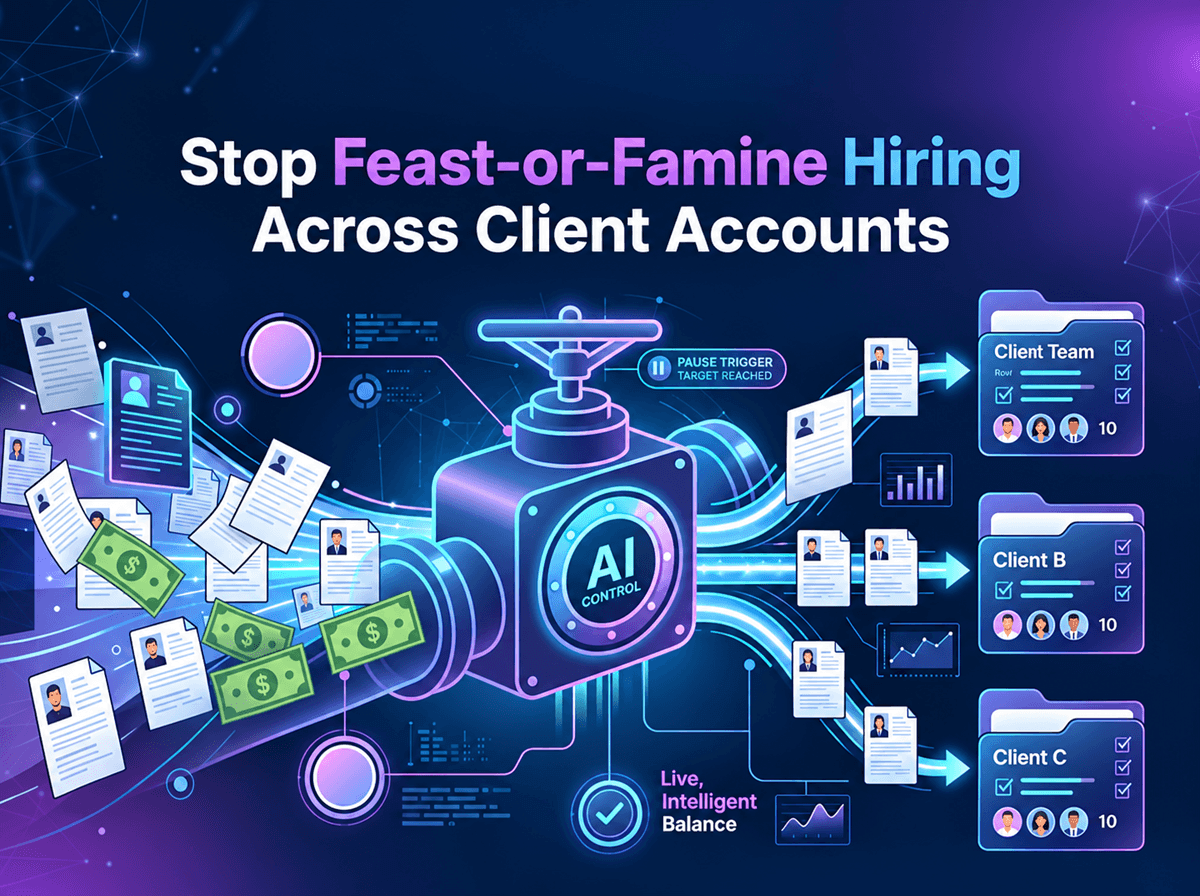
For staffing firms, Recruitment Process Outsourcers (RPOs), and multi-entity enterprise talent teams, pipeline volatility is an operational nightmare. One week, a high-volume client account generates hundreds of applicants that overwhelm recruiters with screening backlogs. Meanwhile, a specialized or high-priority client requisition sits empty, threatening service level agreements (SLAs) and leaving hiring managers waiting.
This erratic “feast or famine” dynamic is rarely a sourcing talent issue; it is a structural budget and distribution failure.
When advertising budgets are allocated statically across disparate client accounts, spend flows toward the path of least resistance. Roles that are simple to fill vacuum up ad spend and applicant volume, while niche, hard-to-fill positions remain starved.
Eliminating this volatility requires shifting from manual, account-by-account job management to portfolio-wide programmatic budget pacing.
Why Client Pipelines Fluctuate Out of Control
Managing candidate volume across dozens of client accounts or divisional requisitions creates compounding logistical hurdles. Three primary factors create pipeline instability:
1. Static Budget Allocations
Traditional recruitment marketing relies on dividing monthly media spend into rigid silos per account or requisition. If Account A receives $2,000 for customer support roles and Account B receives $2,000 for specialized software engineers, Account A often burns its budget within days—generating far more resumes than needed. Account B’s budget slowly ticks down without generating qualified applicant traction, leaving recruiters empty-handed.
2. Disconnected Applicant Feedback Loops
Most job posting channels operate in a vacuum, completely disconnected from what occurs inside your Applicant Tracking System (ATS). Even after an account reaches its required slate of interview-ready candidates, third-party job ads continue running until the calendar duration expires or the budget is completely exhausted.
3. Recruiter Screening Fatigue
Sudden applicant floods cause recruiter bottlenecks. Reviewing 250 unqualified applications for an over-indexed role consumes hours of screening time, pulling recruiter focus away from sourcing candidates for critical, lagging accounts.
How Programmatic Pacing Stabilizes Multi-Account Delivery
Programmatic job advertising replaces static spend allocations with algorithmic distribution that dynamically balances candidate delivery across your entire client portfolio.
Automated Volume Caps Per Account
Rather than letting ad campaigns run unchecked, talent operations leaders set strict applicant target caps for each client requisition. As soon as a requisition receives its designated volume of qualified candidates, distribution automatically pauses across all connected job boards. This stops candidate over-subscription and protects recruiters from screening fatigue.
Real-Time Capital Reallocation Across Client Pools
Under programmatic governance, ad dollars are not trapped in a paused campaign. The platform dynamically reallocates unspent budget from capped, over-performing roles to lagging, hard-to-fill requisitions across other client accounts. This automated shift guarantees that under-indexed requisitions receive instant distribution support without requiring manual budget transfers or client contract amendments.
Omnichannel Placement Across 100+ Publisher Networks
Relying on one or two legacy job boards limits candidate access to identical talent pools. Automated programmatic distribution routes openings across an ecosystem of 100+ job boards, niche aggregators, and social channels simultaneously. If a particular channel underperforms for a specific technical profile, the pacing engine shifts bidding toward publisher networks that historically yield qualified applicants for that discipline.
Manual Account Management vs. Programmatic Portfolio Balancing
| Operational Area | Manual Multi-Account Distribution | Programmatic Portfolio Pacing |
| Budget Management | Fixed spend per account; high ad leakage | Fluid, automated cross-account budget shifting |
| Applicant Flow | Extreme volume spikes and persistent dry spells | Steady, controlled applicant delivery to targets |
| Campaign Governance | Manual daily monitoring and recruiter adjustments | Automated cap rules based on ATS pipeline status |
| Channel Reach | Limited to direct-contract job portals | Automated placement across 100+ publisher feeds |
| Cost Efficiency | High average Cost-Per-Hire due to over-indexing | Up to 45% reduction in Cost-Per-Hire |
| Candidate Quality | Low conversion due to irrelevant volume | 3x increase in qualified applicant flow |
4 Rules for Maintaining Balanced Candidate Flow
Building a balanced, predictable talent delivery model across client accounts involves four core practices:
- Establish Stage-Specific Trigger Rules: Define what constitutes a “filled pipeline” for every client tier. Set automated rules that pause or down-bid job ads once a requisition reaches 10 qualified phone screens or 4 completed hiring-manager interviews.
- Centralize Job Distribution via Unified ATS Feeds: Connect all active client requisitions through a single programmatic feed rather than posting manually to individual boards. This allows your pacing algorithms to monitor performance across the entire account inventory in real time.
- Set Up Tiered Priority Weighting: Assign priority tiers to client requisitions (e.g., Tier 1: Urgent SLA at risk, Tier 2: Standard pacing, Tier 3: Evergreen). When candidate caps pause Tier 2 and Tier 3 positions, surplus budget automatically routes to high-urgency Tier 1 roles.
- Evaluate Cost-Per-Application (CPA) by Role Complexity: Track unit acquisition metrics separately for high-volume roles versus hard-to-fill positions. This prevents high-volume accounts from distorting overall portfolio metrics and ensures client billing reflects true recruitment effort.
Ending the feast-or-famine cycle allows talent acquisition teams and staffing agencies to deliver consistent candidate quality, hit client SLAs on schedule, and eliminate wasted ad spend. By operationalizing automated budget pacing, talent leaders transform chaotic recruitment pipelines into dependable, highly efficient hiring engines.
Eliminate candidate bottlenecks and balance your recruitment spend across every account. Book an enterprise platform demo with Sourcing Square.